

Abstract
STRENGTHENING HEALTH SECURITY THROUGH INTELLIGENT RISK DETECTION SYSTEMS IN PUBLIC HEALTHCARE SETTINGS
Abdullah*
ABSTRACT
Background: Strengthening health security requires effective strategies for identifying and managing public health risks. As one of the most prevalent oral diseases globally, dental caries represents a significant burden on healthcare systems and serves as a key indicator of community health. The early detection of initial lesions is particularly critical to prevent disease progression and reduce treatment costs. However, conventional diagnostic methods, which rely on visual examination and radiography, are often limited by their subjectivity and time-consuming nature, reducing their effectiveness for large-scale screening in public healthcare settings. This challenge highlights the need for intelligent risk detection systems. Artificial intelligence (AI) offers a transformative solution, with the potential to shift disease diagnostics from a reactive to a proactive model, thereby enhancing population-wide health security. Methods: This review highlights how artificial intelligence is transforming the diagnostic process, using dentistry as a powerful example of its broader potential in public health. However, the study also identifies challenges and limitations, such as restricted sample sizes and variability in AI model architectures. Therefore, the findings suggest that further research is needed to validate and scale the application of AI in clinical settings. By enhancing diagnostic accuracy and efficiency, intelligent systems can serve as a vital component in strengthening health security and improving public health outcomes. Results: All included studies demonstrate that artificial intelligence models, particularly deep neural networks, achieve higher accuracy in diagnosing dental diseases from radiographic images. This finding is especially critical for the identification of proximal carious lesions, which are often missed during routine examinations. The results signify a major advancement in early disease detection capabilities, which is a cornerstone of effective health security systems. Conclusions: This review highlights how artificial intelligence is transforming the diagnostic process in dentistry. However, the study also reveals the problems and pitfalls of AI utilization, such as restricted sample sizes and potential differences in the architecture of AI models. Therefore, the findings suggest that more studies are needed to advance the application of AI in clinical settings, as it appears to enhance diagnostic accuracy and effectiveness.
[Full Text Article] [Download Certificate]WJPLS CITATION 
| All | Since 2020 | |
| Citation | 590 | 424 |
| h-index | 12 | 10 |
| i10-index | 17 | 14 |

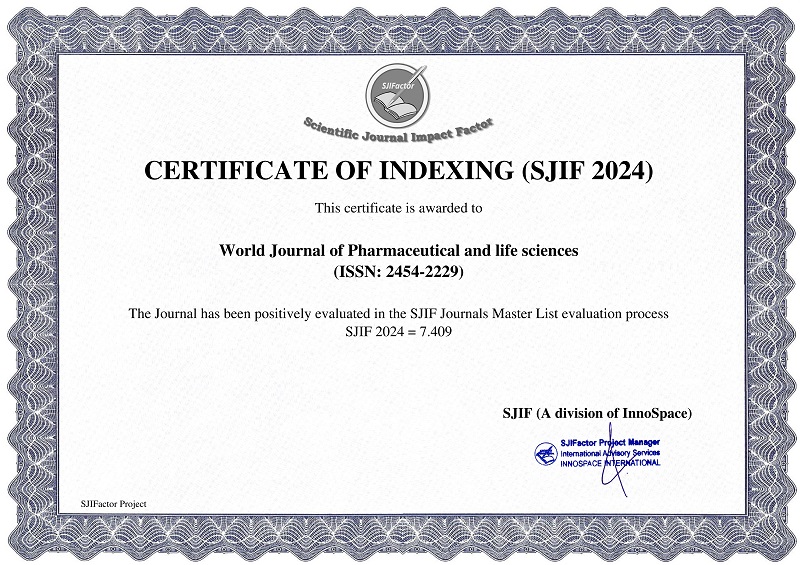
INDEXING
NEWS & UPDATION
BEST ARTICLE AWARDS
World Journal of Pharmaceutical and life sciences is giving Best Article Award in every Issue for Best Article and Issue Certificate of Appreciation to the Authors to promote research activity of scholar.
Best Article of current issue
Download Article : Click here